
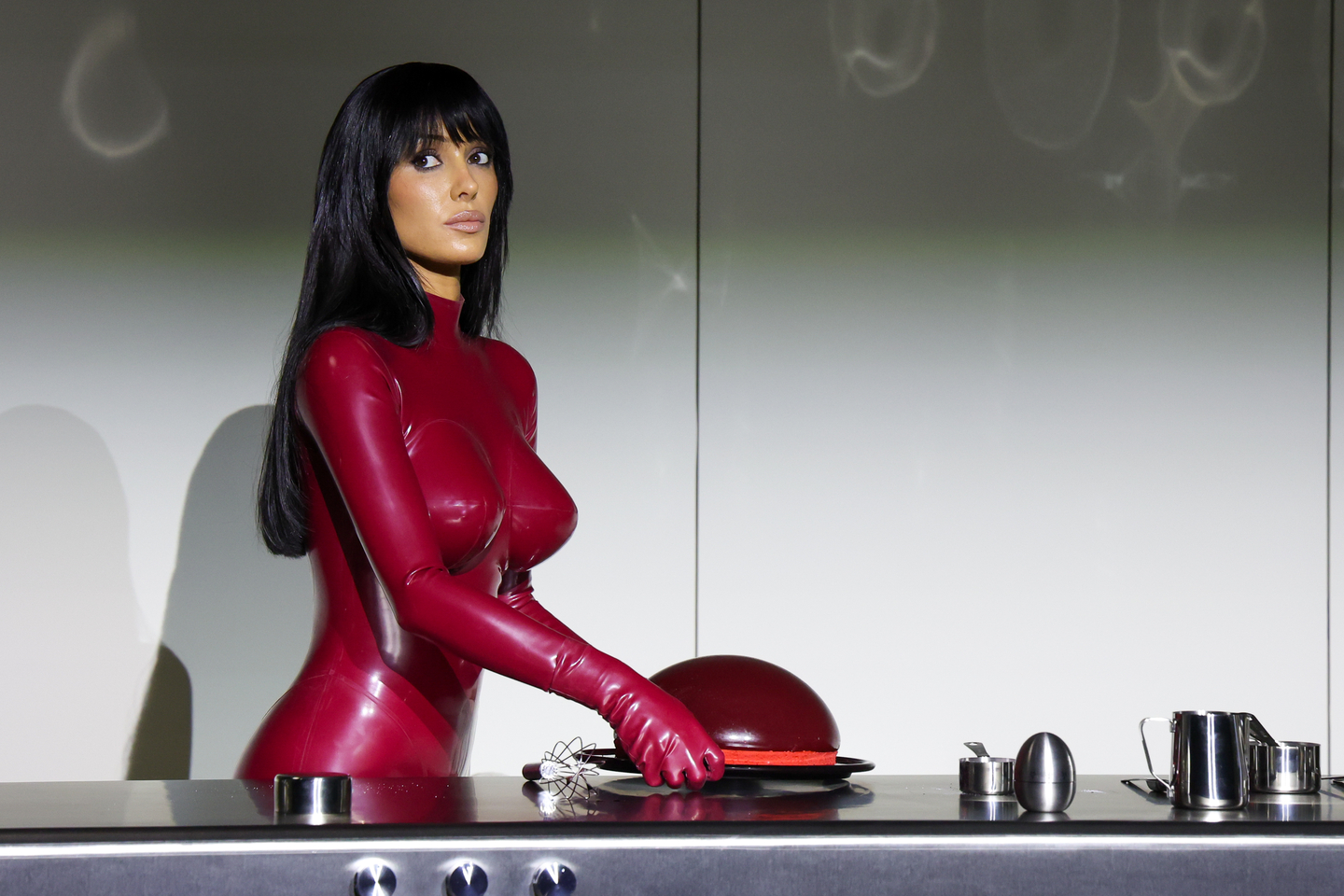
Since 2023, Australian architect Bianca Censori has been impossible to ignore. Her striking fashion moments alongside her famous rapper husband made headlines, yet she rarely speaks, leaving the world to decode her presence. This week, she touched down in Seoul, causing the usual tabloid stir, but the real story was the debut of BIO POP, her first-ever performance art piece.
BIO POP lasted fourteen minutes over two days, and even without a word from Censori, every gesture, pause, and technical glitch was calibrated to command attention. Watching it, it becomes clear: this is more than art. It is a masterclass in the modern attention economy and how spectacle can be engineered.
The performance merges architecture, sculpture, furniture, and movement. The set, split between a pristine kitchen and a living room, is not just a backdrop—it’s an active participant. Think of it as a living billboard where the environment, the objects, and even livestream hiccups amplify the drama. Censori moves delicately around a kitchen, baking a cake she never intends to eat, while a cinematic orchestral soundtrack frames the domestic ritual as high drama. Minimal gestures force the audience to lean in and fill the gaps themselves, proving once again that what you don’t say can be louder than what you do.
BIO POP thrives on discomfort. Furniture contorts the human body into medical-bondage-inspired positions, and doubles of Censori herself populate the set like trapped idols. The comparisons to Allen Jones, the 1960s Kink art legend who turned female figures into literal furniture, are inevitable. But whereas Jones exposed eroticized domestic fantasies in hyper-visibility, Censori reframes the domestic and the body through confinement, ritual, and identity. Her objects are not passive props—they mold the body, turning comfort into constraint and domesticity into architecture. The question lingers: is this a critique of domestic roles, or is it aestheticizing the very system it interrogates?
The performance begins with baking a cake, an act of care transformed into ceremony. The doubles, the furniture, the ritualized space—they invite interpretation. Are these women empowered icons, or extensions of a system that defines them? BIO POP doesn’t resolve this tension. It amplifies it, making viewers ask uncomfortable questions about bodies, roles, and space.
Alongside the performance, Censori unveiled a capsule of sculptural furniture and jewelry. Though for sale, these pieces are extensions of the work rather than conventional merchandise. They echo medical tools, prosthetics, and bondage furniture, blurring the line between functional object and artistic statement. For marketers and creators, this is a masterclass in storytelling through objects: narrative weight carried by what people can touch, wear, and interact with.
BIO POP is the first installment in a seven-year series exploring domestic space, collective memory, and lived experience. Each installment builds anticipation, deepens engagement, and turns audiences into collaborators in meaning-making. Censori herself is inseparable from the work, her fame and persona functioning as both medium and message. Every cryptic detail, every glitch, every silence is optimized for virality, turning speculation into the ultimate distribution channel.
Ordinary gestures—a cake, a kitchen, a living room—are reframed into spectacle, challenging audiences to reconsider domesticity, ritual, and identity. Censori’s cross-disciplinary approach, blending architecture, performance, and sculpture, creates a layered, immersive narrative. In a world obsessed with attention, BIO POP is both art and campaign, a reminder that the most resonant stories often come from merging unexpected elements into a cohesive, thought-provoking experience.
In the end, Censori leaves us with a question that lingers long after the lights dim.
